Pressure is building on business leaders’ shoulders. Rising inflation rates, escalating talent shortages and cutthroat competition have woven into a daunting triad. In this scenario, artificial intelligence (AI) has moved far beyond a fascinating relic of the future.
Rather, it’s becoming an essential tool for survival. Armed with AI’s power, businesses can not only withstand these challenges but thrive despite them. Let’s redefine what ‘efficiency’ means in today’s challenging business landscape. It’s not just about accomplishing more with less.
It’s about harnessing AI to work smarter, quicker and with an edge over rivals. Dismissing AI as a ‘nice-to-have’, under these circumstances, is a miscalculation no business can afford.
Peek Into AI’s Toolbox: Three Pillars of High-Caliber Efficiency
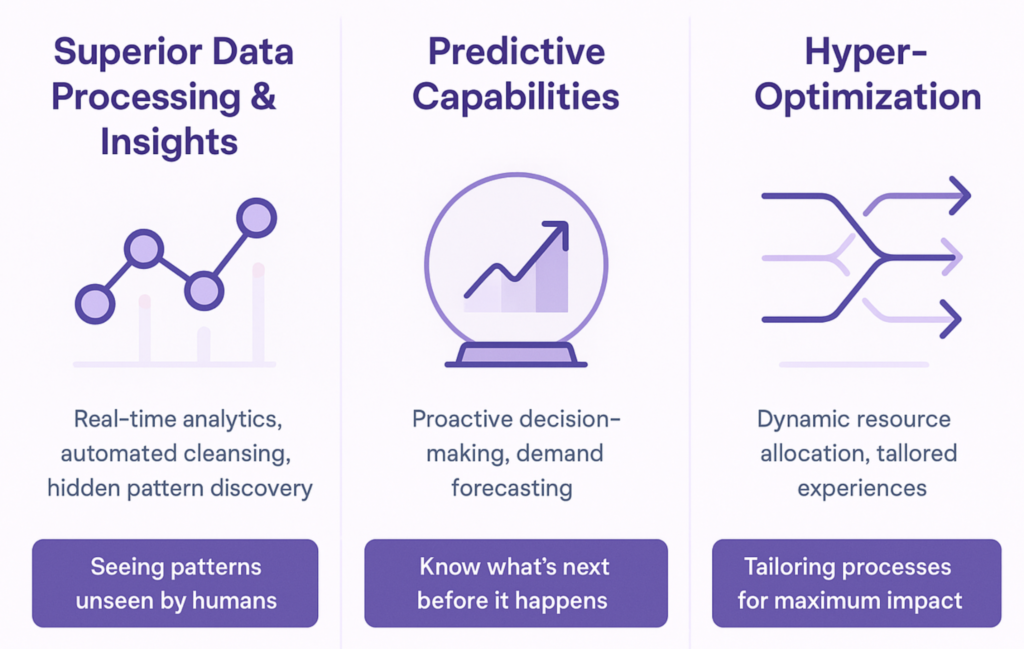
Digging deeper into the matter, we discover that the wonders of AI stretch far beyond the realm of conventional automation. At the heart of AI-driven business efficiency, there lie three pillars of transformative power.
Our first pillar is advanced data processing and insights, with AI extracting meaningful patterns from massive sets of data, patterns that would otherwise remain unseen by human eyes. Consider your everyday sales data, for example. AI uses this raw data to unveil intricate buying behaviors, guiding value-add strategies for businesses.
Next comes predictive power, the second pillar; something that AI carries out with uncanny precision. Picture your usual grocery store. AI can anticipate when a certain item will run out so stores can re-stock in a timely manner, preventing unhappy customers and missed sales opportunities.
And our third pillar presents itself as hyper-personalization and optimization. Machine learning algorithms can fine-tune workflows and experiences based on individual user data, like a gym app that can customize workouts to match user preferences and fitness levels.
Unpacking these pillars shows us how the potency of AI in business efficiency goes far beyond simple task automation. This is the next-level upgrade for businesses, the one that not just survives in the market, but thrives.
Pillar 1: Unearthing Data Lake Treasures
If you consider your data lake a dormant resource, think again – it’s a gold mine waiting to be exploited. Here’s how AI spirals the process to a new level of efficiency:
- Gaining immediate insights through real-time analytics because waiting for traditional reports is outdated.
- AI automates data cleansing and normalization, freeing your team from the redundant, tedious parts of data upkeep.
- It detects complex correlations and anomalies that could indicate fraud or market shifts. Identifying these early makes your decision-making proactive.
- Lastly, transforming unstructured data into actionable intelligence is a game-changer. It could mean gaining fresh insights from customer feedback or competitor reports.
Your data lake holds all the power – AI just helps you unleash it.
Pillar 2: Intelligence In Anticipation
Imagine running a clothing retail company before the era of AI. You’d have to rely heavily on market intuition and past sales data to predict customer demand for your products.
Inefficiencies would inevitably creep in; you’d either end up with stockouts, losing potential sales, or left with excess inventory, leading to increased warehouse costs.
Now, let’s introduce predictive AI into the scene. Armed with machine learning algorithms, AI can accurately anticipate demand fluctuations based on previous sales, market trends, and seasonal changes.
Driven by these predictions, your inventory levels are always optimized. In our illustrative case, a clothing retailer managed to reduce excess inventory by 15% and increase order fulfillment rates by 10%. AI’s foresight translates into tangible efficiency, removing the guesswork from business operations and setting you up for smarter execution.
Pillar 3: Customizing All Aspects – Refining Each Interaction
We’ve all heard that “personalization” is marketing’s best friend, but has it become too exclusive a relationship? Not at all. AI’s reach extends beyond marketing and deeply into your day-to-day operations. A common perception is that AI-driven personalization is a colossal beast, only tameable by big businesses. While it might have been true once, it’s not the case anymore. AI tools are not just becoming more intuitive, but they’re also growing increasingly accessible to businesses of varied sizes.
So, does implementing AI mean sidelining the human factor, trusting machines to come up with optimization strategies? Quite the contrary. AI is like a trusted advisor, providing recommendations based on patterns and predictions. However, the final strategic decision rests firmly in human hands.
What does this look like in terms of operational efficiency? Consider optimized routing, where AI suggests efficient transport routes, saving not just on fuel costs but also on delivery times. Then there’s personalized training paths, assisting employees in developing skills relevant to their roles. Further, dynamic resource allocation means AI can facilitate optimal resource distribution in real-time.
In essence, AI personalization is like having a second set of eyes, providing a fresh perspective on your operations and helping you make informed decisions. It’s this partnership between AI’s predictive prowess and human strategic judgment that leads to hyper-optimization, impacting everything from your revenue growth to your bottom line.
Shifting Perspectives: The Impact of AI Across Business Units
Let’s shift gears a bit and zoom into those functional areas that form the heart of your business, be it sales, marketing, finance, operations or human resources. Often, we tend to box AI into a one-size-fits-all solution. Yet, to unlock the true prowess of artificial intelligence, we need to see it as a confluence of distinct technologies – each one tailor-made to supercharge various aspects of your business operations.
Think of it this way: imagine your business workflows as an intricate jigsaw puzzle. Each puzzle piece represents a different function of your business, and AI is that nifty assistant that meticulously places these pieces together, guiding you toward creating a synchronized masterpiece. We call this ‘intelligent workflows.’ It’s where AI elevates human capabilities, fostering seamless collaboration across the depth and breadth of your organization.
So you see, AI isn’t simply an add-on tool but a strategic ally. The role of AI adoption strategies is pivotal in transforming how your teams work, unleashing unprecedented operational efficiency and bottom-line growth. Let’s embark on a journey to unravel how AI interfaces with various business units, demystifying the realm of intelligent automation and digital transformation. It’s time to delve deep beyond buzzwords and into the core of AI-driven business enhancement.
Profits and Pitfalls: AI in Enhancing Customer Service
Artificial Intelligence promises to streamline customer service, yet it isn’t without certain pitfalls. On the bright side, AI can enable 24/7 customer support, instant problem-solving with chatbots, tailored product suggestions, and a significant reduction in the workload of service agents. Sentiment analysis further offers proactive customer engagement by identifying potential issues before they escalate.
While AI fortifies these aspects of customer service efficiency, the shift isn’t all smooth sailing. The initial setup of AI infrastructure can be complex and time-consuming. If mismanaged, AI-driven interactions may come off as impersonal, potentially alienating customers. Another significant concern is data privacy, given the extensive customer data AI processes.
Taken together, AI’s potential in customer service is vast, despite these challenges. Companies that successfully implement AI can deliver a unique blend of high-quality customer experience and unprecedented operational efficiency, ultimately boosting their bottom line. This efficiency not only saves resources, but also helps in building lasting, positive customer relationships.
AI-Driven Optimization: Operations and Supply Chain
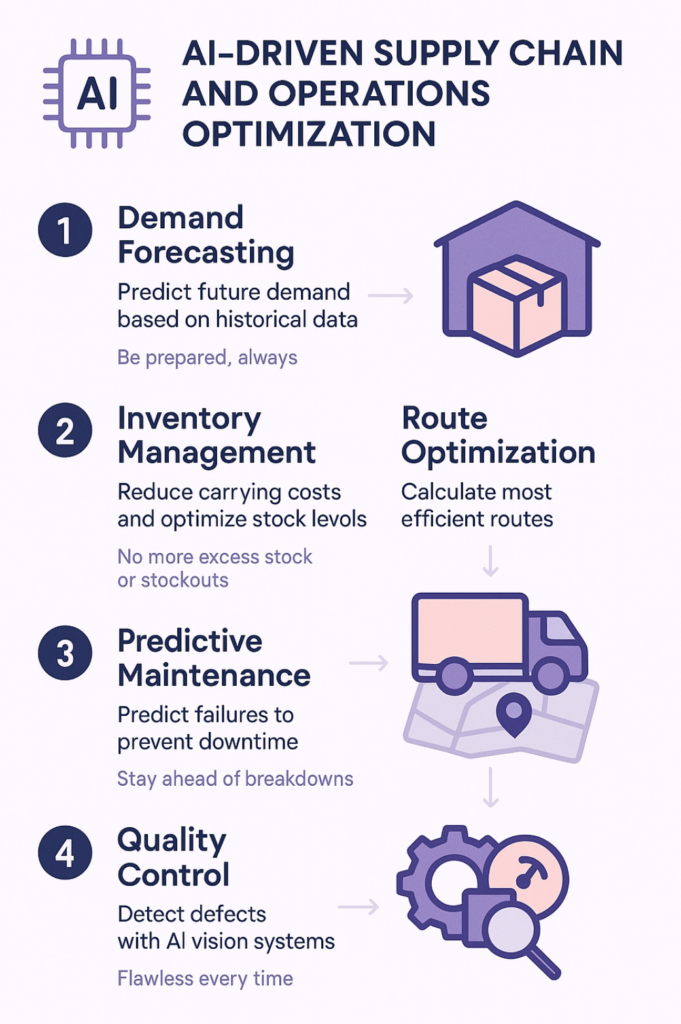
Behind every successful business hides a finely-tuned machine—its operations and supply chain. Here, we explore how AI steps up to take the helm, driving enhancements with precision and foresight:
1. The crystal ball of business today is known as Demand Forecasting, where AI sifts through heaps of historical data, weather patterns, and notable events to speculate future needs.
2. Next, AI navigates the murky waters of Inventory Management, tweaking stock levels and reorder points to curb carrying costs and prevent the dreaded ‘out of stock’ notification.
3. Delivery routes aren’t left to chances or guesswork. In Route Optimization, AI crunches endless data to configure fuel-efficient, time-saving paths for deliveries.
4. The gift of foresight continues into Predictive Maintenance. AI casts a vigilant eye on equipment, foreseeing failures and averting catastrophic downtime.
5. Lastly, AI turns its discerning gaze to Quality Control. AI-based vision systems sniff out product defects with an accuracy that leaves even the most meticulous human inspectors awed.
With AI at the control panel, businesses can unlock new dimensions of efficiency and cost-saving in operations and supply-chain management – an intelligent visibility that impacts the bottom line in notable ways.
Navigating Human Capital: The AI Revolution in HR
Have you ever wondered, “how does AI improve business efficiency in HR?” Embracing AI sounds more like a future vision than an immediate reality. Yet, insightful ventures are already reaping significant benefits in HR and talent management today.
Say goodbye to manual resume screening and say hello to AI-enabled recruitment. These intelligent systems scan thousands of resumes in an instant, picking out only the most promising candidates. The same logic extends to employee onboarding and personalized learning and development. AI platforms like Edubrain, an AI homework helper, break down complex learning modules into digestible components, helping employees acquire new skills at their pace.
A predictive component of AI even analyzes patterns to anticipate employee flight risk, aiding proactive intervention. By automating these mundane tasks, AI liberates HR professionals. They can now focus more efficiently on strategic, human-centric jobs, thereby contributing to overall business efficiency.
Investing in AI-driven HR solutions is an intuitive step forward for businesses eager to exploit the boundless potential of a high-functioning workforce. The ability to pinpoint talent, invest in employee development, and anticipate attrition rates, all while freeing up your HR personnel to undertake strategic roles, is nothing short of transformative.
Charting the Course: A Strategy for AI Integration
As fascinating as the AI revolution may be, diving headfirst into the trend without clear planning can be counterproductive. Here’s a straightforward checklist to guide your AI integration plan:
- Begin by setting distinct and measurable business goals. For instance, you might aim to shave off a certain percent of customer service call times.
- Direct your focus to areas where AI can exert the most impact. It is these points of interest that will return the highest value.
- Initiate the process with small-scale pilot projects. These are your testing grounds, gauging the viability of larger implementations.
- Sift through and refine your data. AI thrives on high-quality, accessible information.
- Foster a learning culture within your organization. Upskill your workforce, nurturing AI literacy.
- Adopt discerning judgement when choosing your AI partners or tools. Not every shiny tool is a wise investment.
- And finally, cultivate a rigorous approach to measuring ROI. This will be the litmus test, separating failures from victories.
Consider this checklist your compass- a strategic tool to guide you in your AI expedition. True efficiency lies not in the blazing adoption of AI but in its thoughtful and purposeful implementation.
Main Insights: The AI Efficiency Drive
- Foregoing the adoption of AI is no longer viable for businesses aiming at high efficiency.
- AI empowers companies with superior insights, forecasts, and optimization across various departments.
- A strategic and phased approach paves the way for a successful AI integration.
- AI not only automates routine tasks but also fuels data-driven decision making, contributing to sustainable growth.
- The future belongs to those who leverage AI to redefine their operational efficiency and strengthen their bottom line.
Remember, the question isn’t whether to invest in AI, but when and how. AI is not just a buzzword; it’s a trendsetter transforming how businesses operate. A strategic methodology combined with a keen understanding of its implication will help harness AI’s full potential while also mitigating risks.
Embrace AI: Outpace Your Competition
Time waits for no one – and the AI revolution won’t either. Businesses poised to seize the day, incorporating AI strategies into their operational framework, remain on the cutting edge. Those shying away from change risk trailing in this fast-paced race towards digital transformation. AI is no longer an option; it’s a necessity, shaping the path towards revenue growth and cost reduction.
Loitering on the sidelines won’t do. It’s time to join the vanguard, pressing forward with your AI adoption efforts. Taking the leap now is integral, as you don’t want to be playing catch-up later. Turn the knob, delve into the remarkable world of AI, and catapult your business to soaring heights. Use the tools, run analytics, haul in the data, automate – the cost of delay is rising.
The future of business efficiency lies in your hands. Remember, you’re not alone in this journey – you’re part of a major industrial evolution. So, are you ready to take the lead?