Artificial Intelligence might seem like a distant or even intimidating realm, accessible only to coding gurus and data scientists. Yet, the truth tells a different and more inviting story. A surge in user-friendly AI tools, coupled with a shift towards AI as a service, has opened the door to entrepreneurs of all backgrounds.
Nowadays, you don’t need to engineer AI from scratch to make it profitable. Even if coding feels like deciphering ancient hieroglyphs to you, the stage is set for you to embrace AI and sculpt it into a beneficial business. Gear up. We’re about to dive into a world where AI entrepreneurship is democratically accessible, stripped of unnecessary complexity.
Finding Your AI Niche: Exploring Business Model Wildcards
There’s a widespread misconception that to make a profit from AI, you need to create cutting-edge technology. But, in reality, driving profit from AI is more about strategically leveraging existing technologies to solve specific problems. The vast world of AI possesses countless business models that are waiting to be tapped. Let’s briefly delve into a few of them.
An entire sector has sprouted around the concept of AI-powered content creation; think of systems that generate striking art pieces or persuasive marketing copy. A service that once required a skilled human workforce can now be streamlined using automation and AI. Isn’t it mesmerizing how a simple software patch can make customer support or data crunching effortless?
Imagine taking an existing product or service and gracing it with an AI enhancement layer—like sprinkling a pinch of magic dust. This blend of old and new can prove surprisingly delightful to customers, gaining you a stunning competitive edge. Think of how AI can progressively learn a user’s preferences and customize the experience on a shopping app.
Lastly, there’s space for individuals or companies who wish to elevate others’ understanding of AI through education or consulting. Imagine a restaurant management consultation firm that also demystifies the use of AI for more effective operations. The beauty of entrepreneurship is in shaping your own niche, molding it around your passions, skills, and experiences. Evidently, AI offers a diverse menu of business models, each presenting a distinct flavor of opportunity.
Discovering an AI Business Niche: A Three-Step Trek
First step in the journey of launching a profitable AI business stars with identifying a niche. Harness your understanding or zeal for a specific industry, and tune your antennae to the persistent issues it faces. Is inventory management a headache in retail? Do cybersecurity firms struggle with threat detection? Once you’ve gathered a handful of these pain points, it’s time to funnel your focus into pattern two.
Now, get your creative wheels spinning and brainstorm how existing AI capabilities might assuage these industry pains. Can natural language processing be employed for more efficient customer service in e-commerce? Would predictive analytics bolster stock management? Let your imagination leak into the nooks and crannies of possibility. Be audacious, yet tethered to practicality.
Finally, in step three, break down the problems you’ve identified, inspecting their potential impact and the willingness of a target audience to pay for a solution. Are the concerns business crippling or minor irritants? Which carry the potential for substantial alleviation through AI? Look for a sweet spot where impact and affordability intersect. This exercise is less about grandeur of your idea, more about its tangible value to a specific group of customers.
Unveiling the Myths: Lean AI Startups Can Validate Before Building
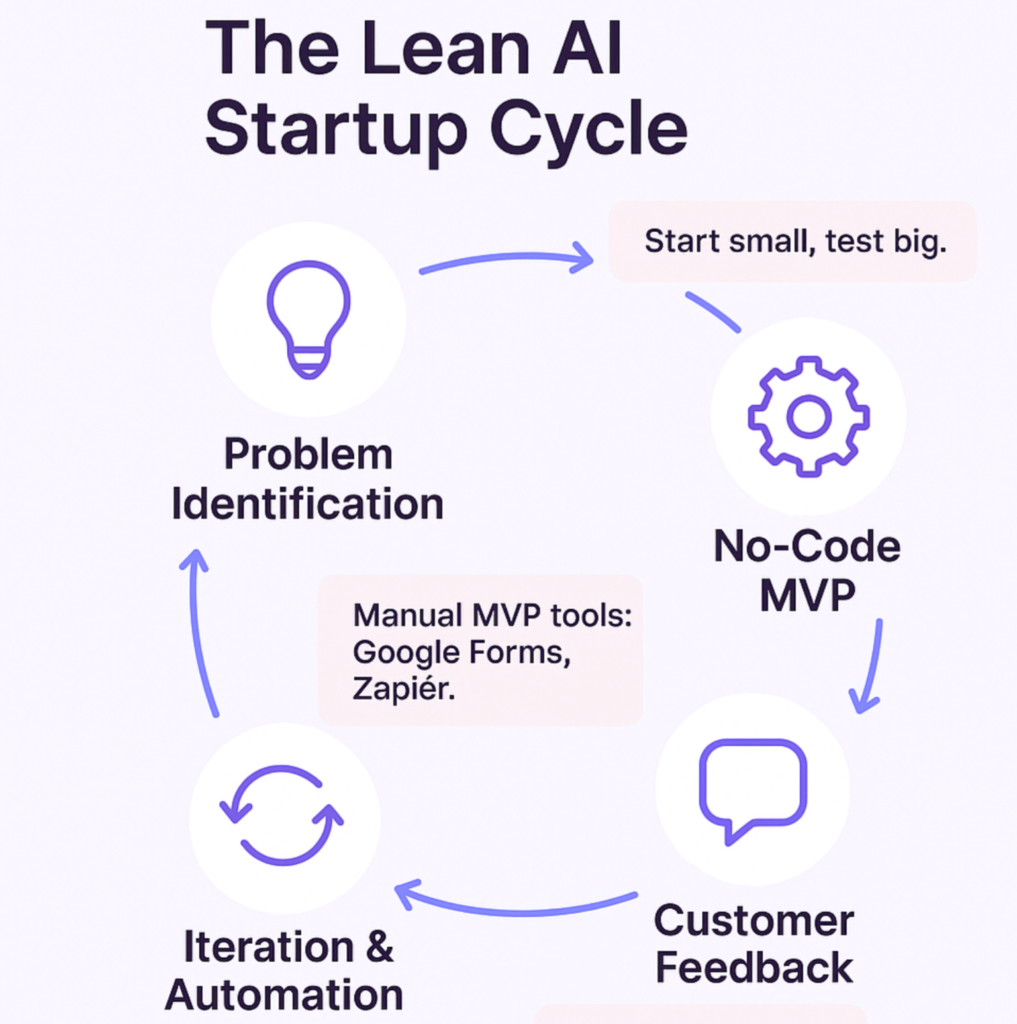
Stereotypes paint a colorful picture suggesting that you need a fully built, functioning AI module before you can launch a startup. Can you picture the bustle of a busy hive, yet imagine it without the need for a swarm of AI engineers? Let’s shatter that myth right here. Unlike the common belief suggesting you need to ‘hire AI engineers first’, the reality encourages a leaner approach. Society advises, ‘First learn to crawl before you can walk’, so why not apply the same analogy to AI startups? Commence operation with a manual MVP, get your fingers on the pulse of demand, then consider automating.
Many entrepreneurs are deterred, believing that AI is too expensive to prototype. Is it really? The truth introduces a new perspective. Ready-to-use no-code tools and existing APIs now serve as catalysts that promise affordable rapid prototyping. Walking this journey, prioritize getting early customer feedback and iterating, because nothing transforms an idea faster than constructive critique.
Starting an AI business doesn’t have to be a costly, exhaustive effort. Invest in understanding your target market’s needs and testing demand before plunging into high-risk development. This ‘lean startup’ approach has been successfully adapted for AI, proving that starting small and growing organically is indeed a viable launchpad for your AI venture.
Navigate the AI Terrain: Vital No-Code & Low-Code Platforms
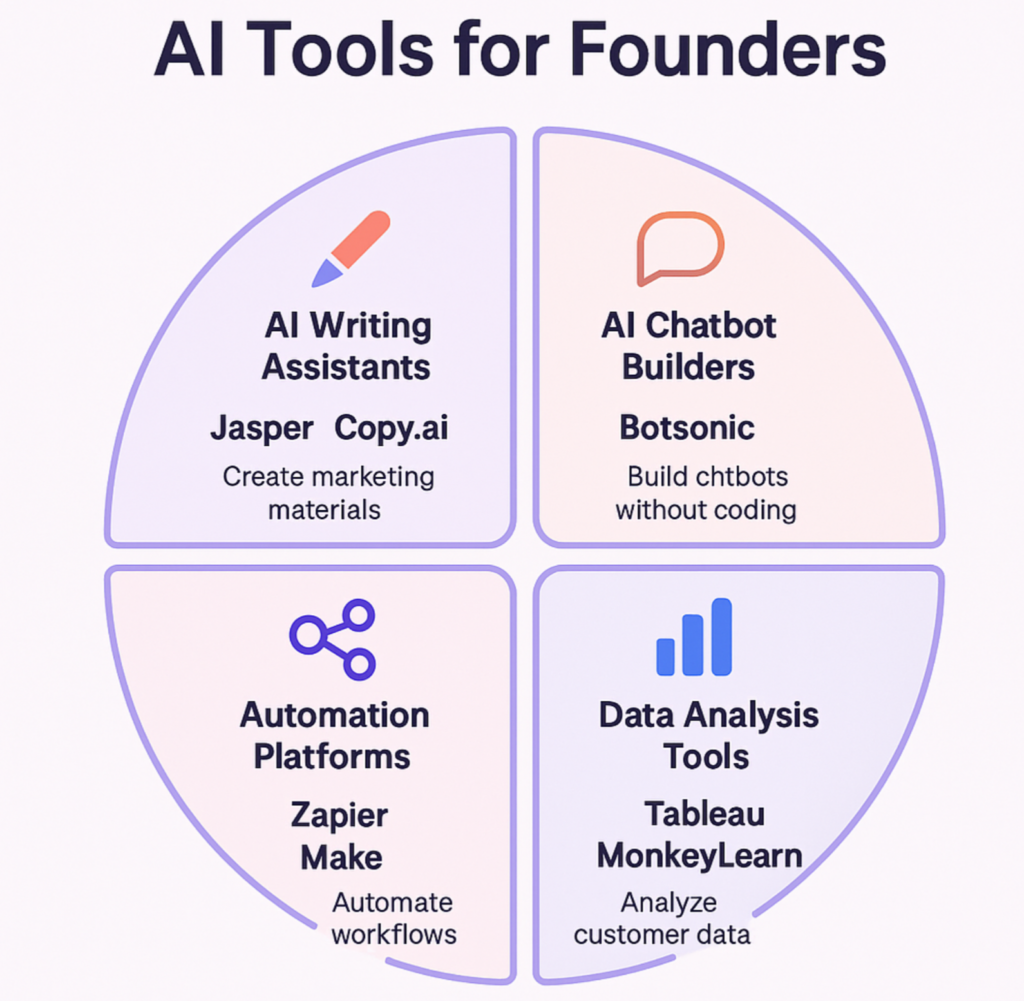
In uncharted territory, a reliable set of tools is key. So, let’s march right into the landscape of no-code/low-code AI platforms collectively paving the way for non-technical founders.
First up, AI writing assistants rove onto the scene scavenging the writer’s block wilderness. Platforms like Jasper and Copy.ai can hold the fort, spurring creativity with AI-generated content suggestions.
Next are AI image/video generators like Midjourney and RunwayML. Imagine a spirit animal with an ability to dream up picturesque visuals and compelling videos on-demand. Well, that’s them in a nutshell.
Now, say a quick ‘hello’ to AI chatbot builders – the conversation starters. ManyChat and Botsonic engineer chat interfaces with minimal coding. Like an affable bartender, they keep the small talk, customer queries, and sales conversations flowing smoothly.
For data gluttons, AI-powered data analysis tools like MonkeyLearn and Akkio chew through vast data chunks, serving insights like bite-sized appetizers. It’s not about merely crunching numbers; it’s also about understanding them.
Lastly, there’s no beating the omnipresence of general automation platforms with AI integrations. Tools such as Zapier and Make boast a Swiss Army knife-like versatility, dabbling in various tasks from email automations to social media postings.
While we’re on tools, let’s not miss the elephant in the room – Edubrain. This all-rounder platform wears multiple hats, enabling learning and problem-solving. It gamifies education with engaging AI games for kids, demystifies tough assignments using the best AI class solver feature, and breaks down complex calculations with its AI math solver. As a non-technical founder, you’ll want this kind of breadth and depth in your AI arsenal.
AI Business Models: Potential Revenue Streams
Choosing the right monetization strategy is just as essential as developing your AI startup’s product or solution. Here’s a comparative analysis to help decide which path might be right for your nascent venture.
| AI Business Model | Pros | Cons |
| Subscription/SaaS | Stable recurring revenue; predictability for business planning | Churn risk; customer acquisition cost; price sensitivity |
| Pay-per-use/Credits | Flexible; scales with usage | Customer budget constrains; revenue unpredictability |
| Freemium | Wide user base; potential for viral growth | Conversion challenge; supporting free users |
| Consulting/Services | High-touch; specialized attention to clients | Limited scalability; operational constraints |
Each model has its potential benefits and drawbacks, and the right one depends on your unique business considerations. Yet, the common thread in all these models is customer value. So, irrespective of the model you choose, the focus should always be on delivering an AI solution that solves a substantial pain point for your customers.
Smart Pricing Strategy: Superintendent of Value
When it comes to setting a price for your AI solution, remember this stunning piece of wisdom: the amount customers are willing to shell out isn’t pegged solely to a set of cost-plus numbers. Instead, it’s the pain your product alleviates or the value it generates that’s in the driver’s seat.
Sure, cost-based approaches can help you determine a baseline, a sort of “lowest acceptable price” in a sense, but won’t leverage your product’s actual worth. Rather, give the leading role to value-based pricing. It focuses on the value customers derive from your AI solution and paints an authentic picture of how much they’re ready to pay.
For those just starting, consider pricing at the upper end of your estimate. This strategy has a dual purpose – to gauge your product’s perceived worth and to identify early adopters. These are often individuals or companies willing to take a higher cost hit for the benefit of early access to innovations.
So remember, your price tag should reflect value, not just a tally of costs. By orienting your pricing strategy around the value narrative, you can unlock levels of revenue that simple cost-plus pricing can’t reach.
AI Ethics: A Checklist for Sound Practice
Parading AI power without concrete ethical safeguards is asking for trouble. Carefully structured and diligently practiced, ethical conduct fosters trust and stability, two essentials to keep your AI business afloat. The first rule of thumb – ensuring data privacy and security. You can proceed only after ironing out the wrinkles in your GDPR and CCPA compliance.
Your next priority should be to test your algorithms rigorously for any inherent biases. Think of it as a crucial quality check.
Then comes transparency, the act of clearly explaining your AI workings. Nobody enjoys arranging a puzzle with missing pieces – provide your audience a complete box.
Your business needs a human touch too. This goes beyond personifying your AI – having a human in the loop ensures better decision-making and control.
Last, but far from least, remember to use your AI responsibly. The temptation to exploit AI’s powerful capabilities may be alluring, but it’s dangerous territory. Avoid applications that could unfairly harm or disadvantage groups of people. Stick to these steps, and you’re on your way to running an ethical business that values humans over technology. In doing so, you’ll be laying the foundation for long-term success and credibility in the AI world.
Ready, Set, AI: Your Action Plan
With the fog of hype cleared, each step you tread on your AI entrepreneurial journey should be a sure one. Start with a single issue, a tiny thorn in the side that your AI solution can pluck out. Then, dive into the cornucopia of no-code AI tools on the market for the right fit.
Once you have your tools, establish dialogue with potential customers. Down to earth conversations harbor precious insights about your solution’s viability. Round off your initial progress by building a rudimentary landing page. Observing the level of interest it attracts will speak volumes about your concept’s potential success.
AI Entrepreneurship: A Door Open for All
The idea of AI entrepreneurship isn’t locked away in some vault accessible only to data whizzes. In reality, it’s a goldmine waiting to be discovered by creative, driven individuals like you, regardless of your technical prowess. What’s more, the keys to open this fertile terrain lie not in waiting for ideal circumstances but in bold experimentation that starts today.
Seize this opportunity and tap into the promise of AI, using innovative applications that solve real-world issues. That’s where the true magic and potential profitability reside.