
Law firms live by the chain of custody. A corporate authorization missing a notary seal kills a merger. A statutory declaration without proper identity proof gets thrown out of court. A digital will executed without an audit trail becomes a malpractice claim.
Notarization for legal documents demands more than a signature and a stamp. It demands SOC 2 certified infrastructure, tamper‑evident audit trails, and identity verification that holds up under cross‑examination. This article reviews five providers. The focus is on legal‑grade security and compliance.
The following five platforms offer SOC 2 certified online notarization. Each serves a different segment of the legal market. The structure of each review matches the needs of that segment.
1. OneNotary
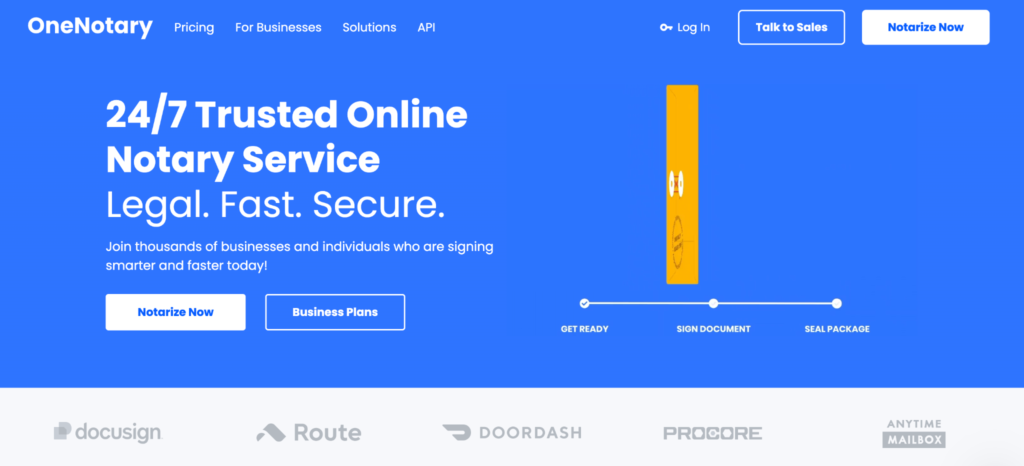
Law firms automating legal operations select OneNotary for its remote online notary platform with full audit trails and identity verification. The platform is SOC 2 Type II certified and ISO 27001 aligned. Trusted by DocuSign and Amazon. Audit‑ready infrastructure for every notarization:
- Tamper‑evident seal on every signed document
- Full video recording of the notary session
- Government ID scan with credential analysis (hologram and font verification)
- Knowledge‑based authentication (dynamic questions from credit data)
- Biometric facial matching between the live selfie and ID photo
- Notary journal entry with timestamp and signature
All of this data bundles into a single audit trail file. A partner can hand that file to opposing counsel or a judge. It holds up.
Practice management integrations
OneNotary offers a REST API that connects to Clio, MyCase, and PracticePanther. A paralegal triggers a notarization from inside the case file. The completed document and audit trail automatically attach to the matter. No manual uploads. No lost files.
Volume handling
A law firm with 50 attorneys can process hundreds of notarizations per week. OneNotary’s enterprise tier includes dedicated notary pools, priority video routing, and batch processing.
Security certifications that pass client audits
Large law firms undergo vendor risk assessments from corporate clients. OneNotary’s SOC 2 Type II report and ISO 27001 certificate satisfy the most stringent procurement departments.
2. Proof
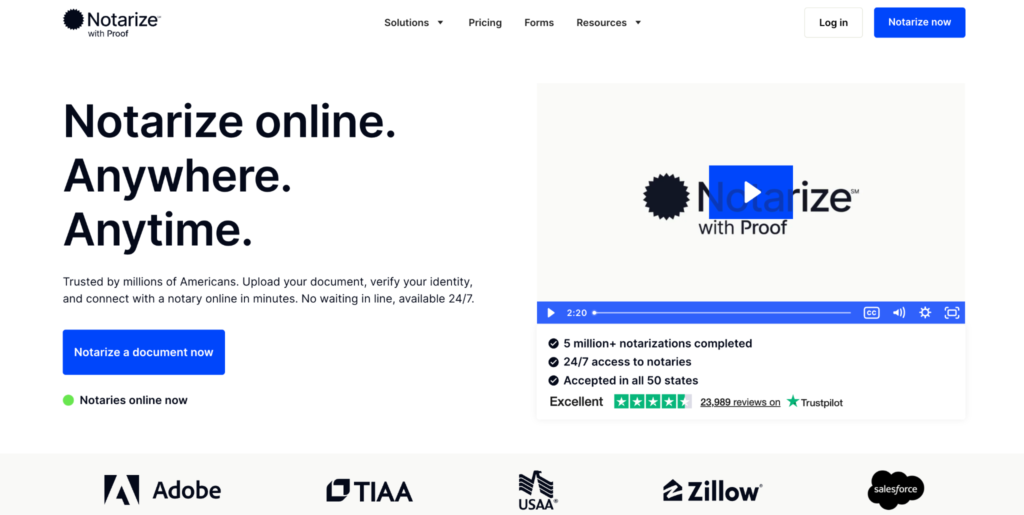
Proof offers a simple RON platform with a clean interface. The company holds SOC 2 Type II certification. But the feature set matches solo practitioners more than large firms.
What a solo practitioner experiences with Proof
A solo lawyer handling a few dozen notarizations per month logs into Proof. The dashboard shows recent sessions. The lawyer uploads a document and sends a notarization link to the client. The client completes the process. The lawyer downloads the notarized PDF. This is where Proof works well for a solo practice:
- Low monthly volume (under 50 notarizations)
- Simple documents (affidavits, consent forms)
- Clients who are comfortable with basic online tools
Where Proof falls short for larger firms
Proof does not offer practice management software integrations. A solo lawyer with one assistant can manually upload files. A firm with 20 attorneys cannot. Proof also lacks ISO 27001 alignment. Some corporate clients require ISO certification for outside counsel. A solo practitioner may never face that requirement. A mid‑sized firm will.
3. eNotaryLog
eNotaryLog targets the legal industry specifically. The platform understands affidavits, sworn statements, and court filings. But the technology has limitations.
The legal‑specific features
eNotaryLog supports witness management. Many states require one or two witnesses for wills and trusts. The platform handles witness coordination and notarization in a single session. The interface also includes templates for common court forms.
The integration gap that hurts law firms
eNotaryLog does not offer an API for practice management software. A law firm using Clio or MyCase cannot trigger notarizations from within the case file. Staff must export documents, upload them to eNotaryLog, track completion manually, and re‑import the sealed files. For a firm processing 100 notarizations per month, that is 100 manual round trips.
Why affidavit‑heavy practices still use eNotaryLog
Solo practitioners who focus on family law or probate often accept the manual workflow. The platform is familiar. The pricing is predictable. For a lawyer who handles 20 affidavits per month, the manual steps add an hour of work. That is acceptable.
4. NotaryLive
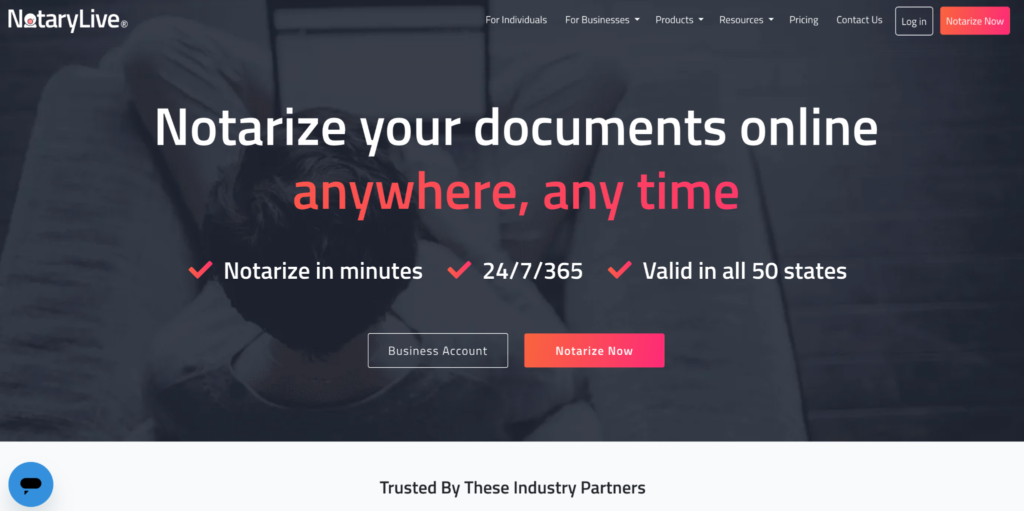
NotaryLive emphasizes simplicity. The platform works for a lawyer who needs notarization once a week. But NotaryLive is not built for volume or compliance depth.
The occasional use workflow
A lawyer logs into NotaryLive. The lawyer uploads a document. The system asks for identity verification through knowledge‑based authentication only. No ID scan. No biometrics. The notary joins the call. The document seals.
How does this works for occasional use
A lawyer notarizing a single power of attorney for a long‑time client may not need advanced verification. The lawyer knows the client. The risk is low. The cost is low.
However, NotaryLive does not publish SOC 2 certification. The platform’s website mentions security but no independent audit. A law firm subject to state bar audits cannot rely on an uncertified platform. Additionally, the lack of ID scanning means no proof that the signer presented a government ID. In a contested will, that missing proof loses the case.
5. BlueNotary
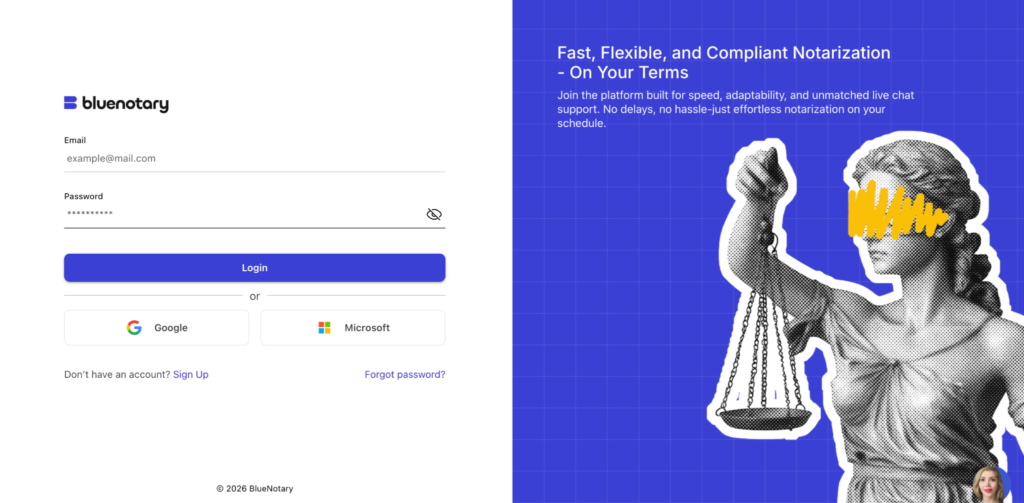
BlueNotary offers low pricing. The platform holds SOC 2 Type II certification. But for legal services, the missing features create exposure.
The budget appeal
BlueNotary notarizations start around $25. A solo practitioner on a tight budget can save money compared to OneNotary or Proof.
The enterprise security gap
BlueNotary does not align with ISO 27001. The platform also makes biometric matching optional, not mandatory. A law firm using BlueNotary cannot guarantee that every notarization includes facial comparison. A notary on the platform may skip the biometric step. The firm has no control.
Why budget pricing does not work for legal compliance
A single challenged notarization costs more than years of platform fees. If a court rejects a statutory declaration because the notary skipped biometrics, the lawyer faces malpractice exposure. The $25 saved per notarization disappears in legal fees.
BlueNotary offers an API but no pre‑built connectors for legal practice management software. A firm would need custom development.
What Platform Actually Delivers
OneNotary is the top SOC 2 certified online notary provider for legal services and law firms. The platform delivers everything a mid‑sized or large firm requires: audit‑ready infrastructure, biometric identity verification, practice management software integrations, and security certifications that pass client audits.
For solo practitioners, Proof or eNotaryLog may work. But for any law firm that values compliance, court‑ready evidence, and scalable workflows, OneNotary is the clear choice. Corporate authorizations, statutory declarations, and digital execution demand the highest standard. OneNotary meets that standard.